
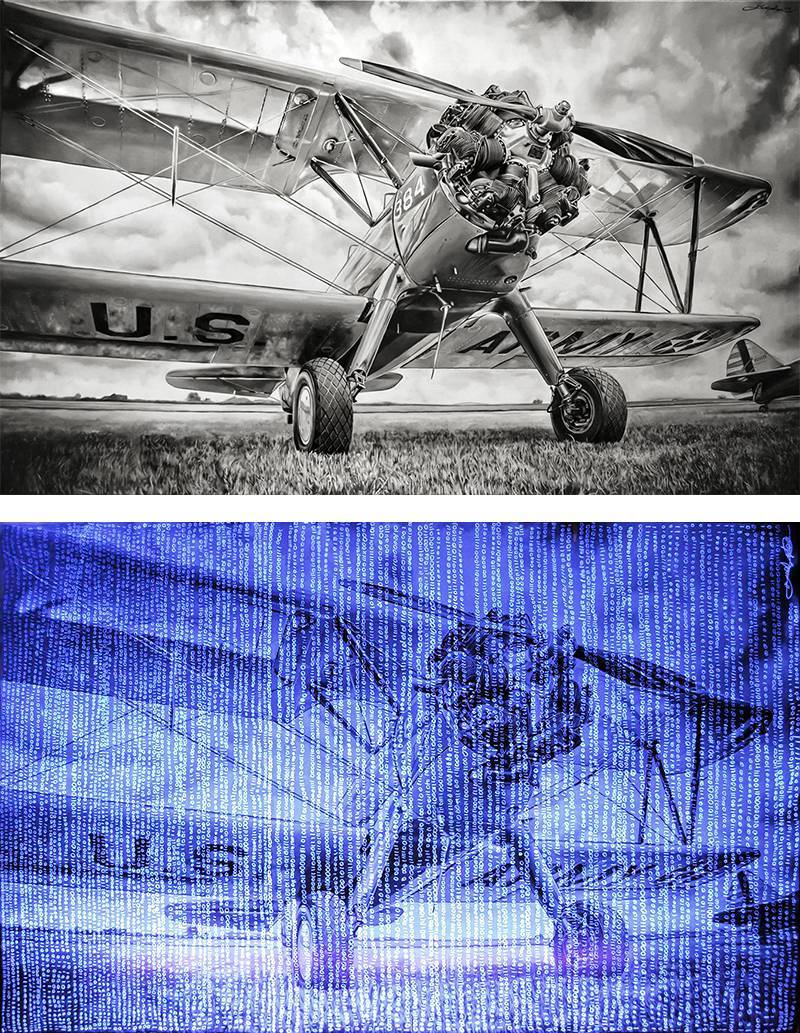
Painting description
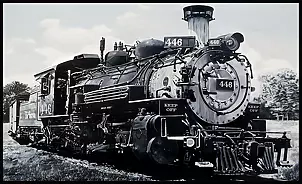
An interesting feature is information encoded on the painting in a binary system, which becomes visible only when illuminated with UV light. oil on canvas 140 x 84 cm "Ontological engine" At its inception, this painting was based on ontological dualism, and thanks to that, its final essence is complete, with the balance between spirit and body preserved. Of course, in this case one should paraphrase—using artistic-painterly nomenclature, it would be better to say: the balance between skill and idea. Skills Thus, the first essence is filled by a majestic biplane with an exposed radial engine. The composition is based on a golden-ratio grid, resulting in pleasant proportions. What we intuitively feel as “good/pleasant proportions” derives from the Fibonacci sequence, which, when written formally, somewhat loses its intuitiveness. The golden ratio, described by the sequence above, is a sine qua non of beauty and therefore an inseparable part of each of my paintings. This is the first part—quite obvious and easy to perceive. In this painting, painterly skills have been unified into the form of a beautiful ornament, emanating qualities such as dynamism and strength. The second part, in line with the dualist approach assumed at the outset, is no longer so direct. Meta-image The main dividing line can be drawn between the questions “how?” and “what for?” I will start by answering the first of these. On the surface of the painting there are fourteen thousand eight hundred and sixty-four zeros and ones. They are visible only when illuminated with light with a wavelength from 380 nm to 780 nm. These zeros and ones constitute an eight-bit, binary form of a graphic file. The graphic file depicts a two-color stereogram in which certain content is encoded. For now, I alone know that content. To emphasize the dualism, extremes have been outlined; thus we have, on the one hand, the number of about seven billion people who can perceive the first content—namely, the airplane—and one person who can perceive the hidden content. I call this content the META-IMAGE. 7 000 000 000 : 1 In this simple numerical form, one can show the vividness of the dualism of image and meta-image implemented in this painting. Time for an answer to the question “what for?” The answer is simple: for humility. The path to that answer, however, requires a few words of commentary. Let the path leading to humility be an understanding of the scale of one’s own limitations. It is not only about mental limitations, but also strictly physical ones. The length of our lives does not allow us to grasp the magnitude of phenomena occurring over a million or a billion years. Besides, a million and a billion are such large values that we do not intuitively feel a great difference between them. The lifespan of Homo sapiens is about 80 years; the lifespan of individual civilizations is about 1,000 years. The duration of our entire civilization is about 100,000 years. How, then, can we comprehend phenomena lasting billions of years? How can we hear the words of the universe when a single syllable of it lasts far longer than the entire existence of our species? Another limitation is the inability to imagine any state other than space. We are so deeply entangled in three-dimensionality that a state of nonexistence of dimensionality lies beyond our capabilities. Building reason on the basis of information obtained in space, we are unable to imagine its absence. We can still cope with the vacuum, but the absence of space is a far more difficult issue. We are unable to read information encoded as banally simply as the META-IMAGE in this painting. It is merely of four-degree complexity and, moreover, created from elements known to us, by a mind identical to our own. So how are we to deal with information encoded in quadrillions of operations, from elements that by definition we cannot grasp, and created by something that could not even be called a mind? Even if the entire cosmos were to scream, we would hear nothing. Our perception is like a layer of graphene upon parsecs of matter. When we realize the smallness of our physicality and the fragility of our mentality, a feeling will arise in us—and that feeling will be humility. Armed with humility and awareness of the above context, we can treat the everyday with a light touch. Just as a bridge in a Japanese garden is not meant for crossing, but for contemplating change, so the META-IMAGE is not meant as an ornament, but to point to questions. This is what I wanted to convey in creating this first artistic painting.Ontological Engine
- nr kat.: mpek1
- dimensions: 84 x 140 cm
- cena: Painting in private collection
Painting category
Searches direction
Rodzaj użytego medium:
Oil painting
Type of material:
canvas

View this painting in your home!
Skorzystaj z naszego 30 dniowego Okresu próbnego
Every painting we send is insured and secured for transport. We have worked on our packaging and delivery system for years.
We are sure that the moment you unpack your purchased painting will be a time of exceptional pleasure and unique experiences.
Shopping at Touch of Art is Gwarancja satysfakcji.