Painting description
Painting Description:
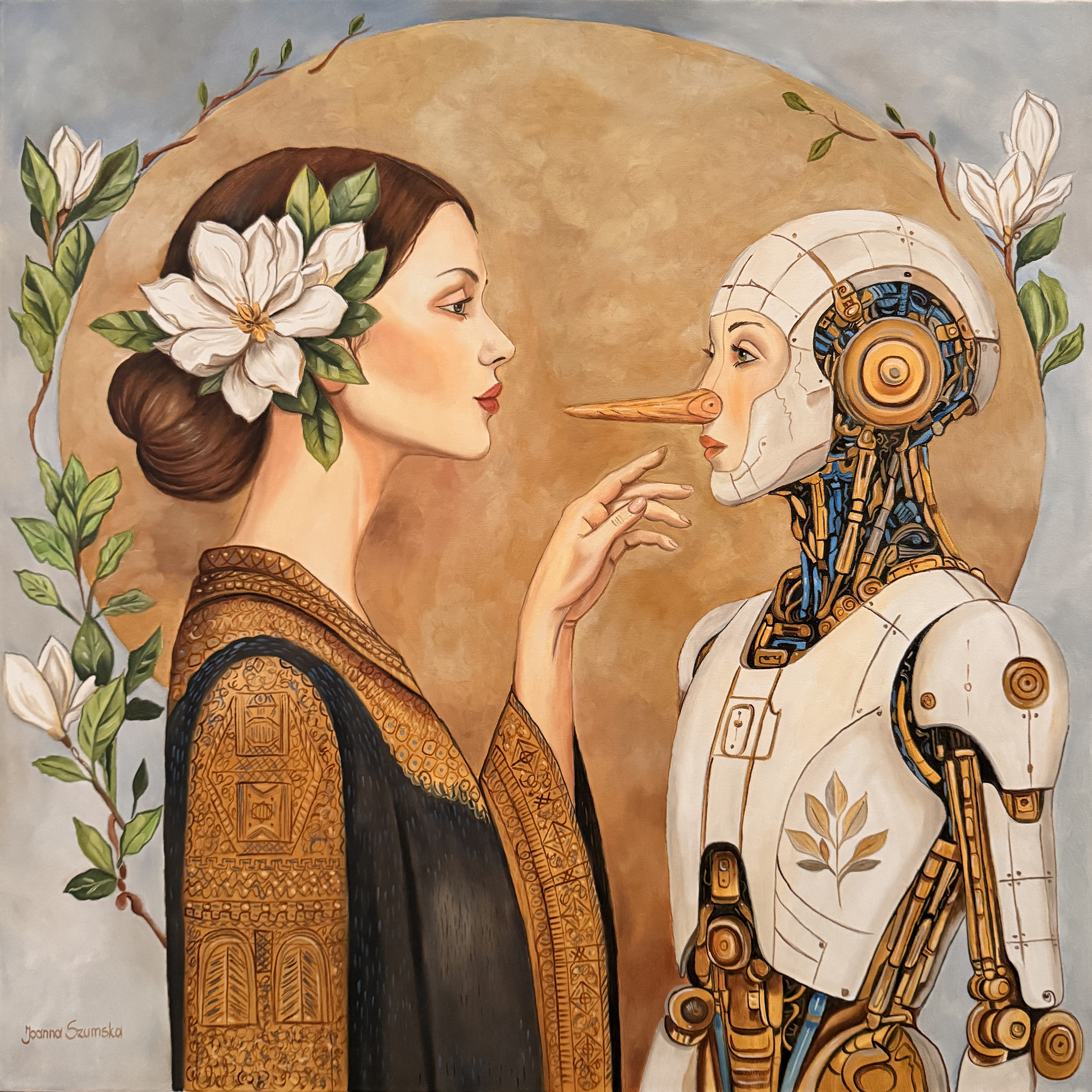
"Pinocchio" is one of the more narrative and symbolic works from Joanna Szumska's "Avatars" series, in which she explores the boundaries between nature, humanity, and technology. The painting depicts the encounter of two beings: a female figure rooted in the organic, natural world and a humanoid robot with a delicate face and an elongated, Pinocchio-like nose. Their mutual gaze and subtle hand gesture create a tension filled with tenderness, uncertainty, and questions about what humanity truly means.
Visually, the painting combines elements characteristic of the artist: the elegance of a female portrait, decorativeness inspired by Art Deco aesthetics, and a soft clash of the organic and mechanical worlds. The magnolia in the woman's hair and the plant motifs on the sides of the composition symbolize nature, intuition, and emotional truth. In turn, the robot—precisely constructed, yet endowed with the fairytale attributes of Pinocchio—becomes a figure of artificial intelligence that desires not merely to "know" but to feel, belong, and be loved.
It is here that the image acquires its philosophical power. "Pinocchio" is not a story about technology as a threat, but about its longing for what is most human and impossible to fully program: love, connection, emotion, and the need to be recognized by another. In this sense, Joanna Szumska's work becomes a contemporary parable about the soul—not as a religious concept, but as a space of emotion, closeness, and the desire for true existence.